Friday, March 12, 2010

ITGW B2 Caves of Chaos is Go!

UPDATE: read the Caves of Chaos Game Report

At the Austin D&D March Meetup I'll running B2 Caves of Chaos for International Traditional Gaming Week at BattleForge Games in Austin Texas March 21st! 

Classic D&D - B2 The Caves of Chaos
DM - Norman J. Harman Jr.
The thick, twisted tree trunks, unnaturally misshapen limbs, writhing roots, clutching and grasping thorns and briars all seem to warn and ward you off, but you have hacked your way through regardless.  Now you have stepped out into a ravine like area.  The dark, streaked rock walls rise rather steeply to either side to a height of about 100' or so.  Clumps of trees grow here and there.  At varying heights on all sides of the ravine, you can see the black mouths of cave like openings.  The sunlight is dim, the air dank, there is an oppressive feeling here.  A flock of ravens rise croaking from the ground, the beat of their wings and their cries magnified by the terrain to sound loud and horrible.

You know that you have certainly discovered the Caves of Chaos.


Come play one of the originals, B2 Caves of Chaos, perhaps the very module you or your father learned how to play D&D with.  Test your mettle vs the evil denizens of the caves.  Face and defeat molemen, kobolds, orcs, zombies, ogres, warangatangs, and the dreaded Owlbear.  Do you have what it takes to survive?  Can you clear out the caves and bring Law to the wilderness!?

Fast & fun, few rules, very easy to learn.  New players encouraged to join in the fun.  Everyone welcome.


I'm running this one-shot to celebrate International Traditional Gaming Week, http://www.traditionalgaming.org/targa-itgw-2010.html.  And also as a prelude to my 12 hour B2 marathon April 3rd at FLGS Dragon's Lair in Austin, TX.  The attentive will note some alterations to B2; molemen, warangatangs? What can I say I like Traditional Games but I'm not very traditional.  Gotta mix some mutant future.  Also, changed up the caves to keep them fresh and challenging to those who have trod all over the original caves.

Exponential Number Encountered

[Very short idea I had while hitting snooze button over and over.]

Instead of linear 1d6, 1d10*30, 1d100 or bellcurved (perhaps unintentially) 2d6, 3d36 I'd like to have an "exponential" scale.

For instance, the surface of Hell Pit Megadungeon (think Caves of Chaos at Grand Canyon Scale whose bottom is also entrance to / the underworld i.e Hell) is crawling with undead.  When skeletons come up on encounter table, should be a couple dozen most of the time, but occasionaly a veritable horde of 100 should be seen shambling towards the party.  Thus the...

Exponential # Encountered Chart (d10)

1: 1
2: 2
3: 4
4: 8
5: 10
6: 12
7: 16
8: 20
9: 30
10: 100


Any sort of chart can be used, smoother, more granular, d6 for OD&Dists.  One generic chart and/or specific charts for different critters.

Another option, one I think is wankier, YMMV.

1: d4
2: d6
3: d8
4: d10
5: d12
6: d20

7: d30
8: d100


I'd prefer to dispense with chart and use dice directly.  But, I'm not aware of very many options for that.  Doubling Die.  Using blank dice and Sharpie.


This, of course, can be used for other variable rolls such as # gp in a sack, days of sickness, length of blizzard in hours, etc.


Part of the desire is to create OMFG moments. Similar to what happens when nat 20 is rolled at critical moment.  Having 1 value way out there makes it special, noticeable and something to avoid (skeletons) or hope for (gold pieces).  For same reason I'd have players understand the chart and roll the dice.

Thursday, March 11, 2010

AC Bonus vs Save, Death Match!

For various reasons I'm really wanting AC to be only armor and not a bunch of other stuff e.g. dex bonus, magic bonus, spell buff. I'm also trying to eliminate as many modifiers during game play as possible.

Using Target 20 with only positive AC (10-0). No Dex modifiers. I was also gonna ditch +x items until I read this magical +x bonus dice mechanic. Which is a great method for handling +x protective items. (well not so sure about picking two numbers and rolling multiple d20's rather than one number and d10's or picking one number per bonus and rolling single d10). Might even use it for shield bonus. Although, keeping "magic" as a separate/special mechanic has appeal.


It So Awesome

It makes +x magic less mundane. It also has the same effect of "Saving throws must be requested by players"(lost link). It puts more of players fate in to their hands. Like The Mule said it provides dramatic tension and excitement at the table over rolling dice.
"... take aspects of the game that normally get resolved off-screen beforehand and instead make them happen at the table as the spotlighted consequence of a dramatic event."

"... even if a PC’s magical protection will stop a blow most of the time, I want to make the players sweat in the interval between when I announce the hit and when their magic save comes through for them!"
And it speeds combat resolution.
"... dozens of men-at-arms in the combat it’s much easier if I can just roll a handful of dice and count all the 17s or above, knowing that such rolls always have a chance of hitting any target."

Lies, and Damn Lies

I was real curious about the statistical analysis. So, I broke out my Python dice code and ran (a lot) of tests. First, some results I'm not gonna bother showing you:
  • picking one number and rolling d10 was close enough to picking two numbers and rolling d20 that I'm only using former.
  • picking one number and rolling d20 caused even greater variation than d10s so ditched that idea.
So, pick one number, roll d10's equal to bonus, if number comes up then no hit (a save). Bonus from 1 to 3, to hit from 1 to 9, even ACs 10 to 2. Random results (rather than calculated) so 100,000 swings were made per row.

d20 + (AC-bonus) + tohit >= 20 is a hit
d20 + AC + tohit >= 20 and failed save(s) is a hit

100000 iterations of +1 tohit vs +1 to AC or 1d10 save rolls.
hit w/ bonus | hit w/ saves | diff |
AC 9 54.92% | AC 10 53.94% | 0.98% |
AC 7 45.07% | AC 8 44.94% | 0.13% |
AC 5 34.93% | AC 6 35.96% | -1.03% |
AC 3 24.85% | AC 4 26.88% | -2.03% |
AC 1 15.02% | AC 2 18.06% | -3.04% |

100000 iterations of +1 tohit vs +2 to AC or 2d10 save rolls.
hit w/ bonus | hit w/ saves | diff |
AC 8 50.27% | AC 10 48.79% | 1.48% |
AC 6 40.05% | AC 8 40.63% | -0.58% |
AC 4 30.09% | AC 6 32.64% | -2.55% |
AC 2 20.12% | AC 4 24.42% | -4.30% |
AC 0 9.97% | AC 2 16.18% | -6.22% |

100000 iterations of +1 tohit vs +3 to AC or 3d10 save rolls.
hit w/ bonus | hit w/ saves | diff |
AC 7 44.84% | AC 10 43.78% | 1.06% |
AC 5 35.04% | AC 8 36.30% | -1.26% |
AC 3 25.00% | AC 6 29.23% | -4.23% |
AC 1 15.03% | AC 4 21.96% | -6.93% |
AC -1 5.00% | AC 2 14.53% | -9.52% |


100000 iterations of +2 tohit vs +1 to AC or 1d10 save rolls.
hit w/ bonus | hit w/ saves | diff |
AC 9 60.14% | AC 10 58.63% | 1.51% |
AC 7 49.67% | AC 8 49.26% | 0.42% |
AC 5 40.20% | AC 6 40.66% | -0.46% |
AC 3 29.76% | AC 4 31.36% | -1.60% |
AC 1 19.88% | AC 2 22.25% | -2.37% |

100000 iterations of +2 tohit vs +2 to AC or 2d10 save rolls.
hit w/ bonus | hit w/ saves | diff |
AC 8 54.93% | AC 10 52.52% | 2.41% |
AC 6 45.04% | AC 8 44.53% | 0.51% |
AC 4 35.14% | AC 6 36.41% | -1.26% |
AC 2 24.88% | AC 4 28.32% | -3.44% |
AC 0 15.02% | AC 2 20.10% | -5.08% |

100000 iterations of +2 tohit vs +3 to AC or 3d10 save rolls.
hit w/ bonus | hit w/ saves | diff |
AC 7 49.80% | AC 10 47.04% | 2.76% |
AC 5 40.08% | AC 8 40.14% | -0.05% |
AC 3 29.80% | AC 6 32.88% | -3.07% |
AC 1 20.01% | AC 4 25.37% | -5.36% |
AC -1 9.88% | AC 2 17.97% | -8.09% |


100000 iterations of +3 tohit vs +1 to AC or 1d10 save rolls.
hit w/ bonus | hit w/ saves | diff |
AC 9 64.88% | AC 10 62.93% | 1.95% |
AC 7 54.92% | AC 8 53.98% | 0.94% |
AC 5 45.21% | AC 6 45.25% | -0.04% |
AC 3 34.89% | AC 4 35.91% | -1.02% |
AC 1 24.94% | AC 2 27.00% | -2.06% |

100000 iterations of +3 tohit vs +2 to AC or 2d10 save rolls.
hit w/ bonus | hit w/ saves | diff |
AC 8 60.03% | AC 10 56.57% | 3.46% |
AC 6 50.16% | AC 8 48.76% | 1.40% |
AC 4 40.01% | AC 6 40.51% | -0.50% |
AC 2 29.96% | AC 4 32.17% | -2.21% |
AC 0 19.80% | AC 2 24.21% | -4.41% |

100000 iterations of +3 tohit vs +3 to AC or 3d10 save rolls.
hit w/ bonus | hit w/ saves | diff |
AC 7 55.19% | AC 10 51.02% | 4.17% |
AC 5 44.88% | AC 8 43.71% | 1.17% |
AC 3 35.09% | AC 6 36.39% | -1.30% |
AC 1 25.08% | AC 4 29.24% | -4.16% |
AC -1 14.93% | AC 2 21.82% | -6.89% |


100000 iterations of +4 tohit vs +1 to AC or 1d10 save rolls.
hit w/ bonus | hit w/ saves | diff |
AC 9 69.88% | AC 10 67.56% | 2.32% |
AC 7 59.88% | AC 8 58.40% | 1.48% |
AC 5 49.88% | AC 6 49.41% | 0.46% |
AC 3 39.81% | AC 4 40.42% | -0.61% |
AC 1 29.93% | AC 2 31.30% | -1.36% |

100000 iterations of +4 tohit vs +2 to AC or 2d10 save rolls.
hit w/ bonus | hit w/ saves | diff |
AC 8 65.08% | AC 10 60.70% | 4.39% |
AC 6 55.06% | AC 8 52.74% | 2.33% |
AC 4 44.89% | AC 6 44.57% | 0.32% |
AC 2 34.79% | AC 4 36.24% | -1.44% |
AC 0 24.91% | AC 2 28.47% | -3.55% |

100000 iterations of +4 tohit vs +3 to AC or 3d10 save rolls.
hit w/ bonus | hit w/ saves | diff |
AC 7 59.88% | AC 10 54.75% | 5.12% |
AC 5 49.85% | AC 8 47.28% | 2.58% |
AC 3 39.95% | AC 6 39.99% | -0.04% |
AC 1 30.00% | AC 4 33.13% | -3.12% |
AC -1 20.10% | AC 2 25.47% | -5.37% |


100000 iterations of +5 tohit vs +1 to AC or 1d10 save rolls.
hit w/ bonus | hit w/ saves | diff |
AC 9 75.06% | AC 10 72.03% | 3.03% |
AC 7 65.09% | AC 8 63.13% | 1.96% |
AC 5 55.04% | AC 6 54.02% | 1.02% |
AC 3 45.02% | AC 4 45.05% | -0.03% |
AC 1 35.12% | AC 2 36.18% | -1.06% |

100000 iterations of +5 tohit vs +2 to AC or 2d10 save rolls.
hit w/ bonus | hit w/ saves | diff |
AC 8 70.03% | AC 10 64.62% | 5.41% |
AC 6 60.14% | AC 8 56.71% | 3.43% |
AC 4 50.14% | AC 6 48.62% | 1.52% |
AC 2 40.18% | AC 4 40.70% | -0.52% |
AC 0 29.88% | AC 2 32.31% | -2.43% |

100000 iterations of +5 tohit vs +3 to AC or 3d10 save rolls.
hit w/ bonus | hit w/ saves | diff |
AC 7 65.13% | AC 10 58.43% | 6.70% |
AC 5 54.95% | AC 8 51.22% | 3.74% |
AC 3 45.00% | AC 6 43.71% | 1.29% |
AC 1 34.64% | AC 4 36.24% | -1.60% |
AC -1 24.99% | AC 2 29.20% | -4.21% |


I think you get the idea. Here's the last one, +9 tohit.


100000 iterations of +9 tohit vs +1 to AC or 1d10 save rolls.
hit w/ bonus | hit w/ saves | diff |
AC 9 94.98% | AC 10 90.01% | 4.97% |
AC 7 84.99% | AC 8 81.21% | 3.79% |
AC 5 75.22% | AC 6 72.21% | 3.00% |
AC 3 65.39% | AC 4 63.32% | 2.07% |
AC 1 55.01% | AC 2 53.99% | 1.02% |

100000 iterations of +9 tohit vs +2 to AC or 2d10 save rolls.
hit w/ bonus | hit w/ saves | diff |
AC 8 90.07% | AC 10 80.90% | 9.18% |
AC 6 79.95% | AC 8 72.97% | 6.99% |
AC 4 69.93% | AC 6 65.15% | 4.78% |
AC 2 59.94% | AC 4 56.60% | 3.34% |
AC 0 50.31% | AC 2 48.89% | 1.41% |

100000 iterations of +9 tohit vs +3 to AC or 3d10 save rolls.
hit w/ bonus | hit w/ saves | diff |
AC 7 85.17% | AC 10 72.73% | 12.44% |
AC 5 74.89% | AC 8 65.72% | 9.17% |
AC 3 64.87% | AC 6 58.25% | 6.62% |
AC 1 54.97% | AC 4 51.16% | 3.81% |
AC -1 45.11% | AC 2 43.69% | 1.42% |

Conclusion
  • The difference between normal AC modification and save mechanic vary greatly depending on mix of AC, tohit, bonus.
  • The difference between normal AC modification and save mechanic regularly very large 5-10%
  • Save mechanic starts out mostly worse than AC modification. This gradually changes as tohit bonus increases. At +9 save is always better than AC modification.
  • Save mechanic compresses to hit percentage range i.e. AC10 is less likely and AC2 more likely to be hit.
  • The worse your AC is, the more beneficial saves are. Means bonus items are more valuable to low AC types.
  • The better tohit bonus opponent has, the more beneficial saves are. Means bonus items are less helpful vs weak opponents and very helpful against high lvl threats.
I don't think it bothers me much that this mechanic produces quite different results than modifying AC.

This save mechanic fits very well my ideal for shields. Providing large bonus to light armor and less and less as armor improves. Not mucking up AC, would blend nicely with shields shall be shattered, no changing ac if shield is / is not used. But then I thought of all the freakin dice rolls. Even if used just for +x protective magics I gotta think 1/2 the party is gonna have those and need to make extra dice rolls during combat.

I've become less sold. I really need to try it out in play.

BTW this mechanic is "reversable" for use with +x weapons. If miss with one use similar save mechanic to see if magic makes it a hit anyways. Very powerful for those who can't hit worth a damn. Less useful to martial masters. That sits well with my sensibilities.

Wednesday, March 10, 2010

Death Bed

aka Mortis Mattress

This relative of the lurker and mimic looks like a four post bed of the comfy sort. The type one would use in conjunction with Cunard's Cozy Comforter of Restful Repose. It is, of course, a voracious monster bent on eating anyone who wanders near. When encountered, DM should roll reaction (or d6 if reaction not used). This will determine how long since the creature's last meal. If not very hungry the creature will be quite patient and cunning waiting for its occupant to fall asleep before indulging in a late night snack. Conversely, a starving bed will be very aggressive springing its attack on those who merely sit on it's edge. OTOH a fully satiated bed might not even nibble on someone resting a full eight hours on it.

Death Beds are fully mobile and are as fast as an unencumbered man. Their primary attack is two great enveloping "wings" from either side, much like a manta ray's. These grapple, trap, and suffocate in addition to secreting digestive juices for 1d6 hits a round. Death Beds may also bludgeon up to four separate annoyances with kicks and "punches" from it's posts. Note: due to their wide spacing no two posts may attack the same target. Some specimen's have a toothy maw which on a critical hit will swallow whole small morsels such as hobbits, children and dogs. Meals so ingested will be slowly(1d6/rnd) digested and they or what's left of them may be recovered from hacking into the "mattress".

Unless extreme measures are taken (called shots) those being consumed will take 1/2 of any damage inflicted on the bed. Death Beds are immune to electricity, sonics, gases, suffication, and aren't terribly put out by water. They d0n't breath or have hearing (they do sense vibrations). Take only half damage from cold. And if you use such modifiers, aren't as damaged by blunt and piercing weapons as they are slashing/chopping types. Fire is their bane, taking double damage from it and very easily catching on fire for continuing damage.

Death Beds accumulate gemstones in a gullet like organ they use to grind bones. Their lairs will have, in out of the way area, small piles of inorganic gear. The remains of previous meals and the creatures "dung". But, they rarely stay in one area for very long. Preferring to sample the local fair and then move on before being discovered. It is unknown how they travel great distances. They have been discovered and exterminated in taverns and noble manors. One would expect a bed walking in the front door to be noticed.

Lessor and weaker versions (cots, simple beds) are known to exist. Whether these are different species or the juvenile forms is hotly debated by monsterologists!

Sigh, I think that is the lamest image I've ever put on this blog.

Tuesday, March 9, 2010

Review of A Magical Society: Silk Road

I dig Expeditious Retreat Press, and not only cause they're named after one of my favorite spells. Their "A Magical Society" series has consistently been good. I recently got a great deal on eBay and added Silk Road to my collection. It's a supplement I hadn't realized was so great or I'd have bought it sooner. You can get yours in dead tree, $27 or electronic, $13 versions.

A Magical Society: Silk Road is 160 page OGL (nominally d20) supplement detailing great overland trade routes akin to the Historic Silk Road. Six Chapters, some Maps, Appendix, Bibliography, no index (although for this book I don't think it's a big deal)


Chapter 1 - Components of Silk Roads

Discusses the geographic foundations, cultural groups, and common attributes that form silk roads. Fascinating discussion of what caused the historic Silk Road and the salient features required to create one in your world.

So simplified as to probably be unintelligible it goes like this -> Geographic barriers isolate bordering cultures. Barrier cultures migrate to (are forced into) the barrier zone. Eventually rich bordering cultures on opposite sides of barrier get a hankering for each other's luxuries and bam! silk road with barrier cultures as middlemen.


Chapter 2 - Traveling on Silk Roads

Drilling down from the foundation of chapter 1 this chapter explains how to connect border civilization centers to each other across barrier zone(s). Identifying crossroads, major trade centers, and specific routes.

Second part of chapter details who travels the silk road. What they need to consider (planing, navigation, animals, currency, language) and what effects they cause such as spreading culture and religion.


Chapter 3 - Types of Caravans

Covers (in detail) landscape, hazards, avoiding/surviving them, animals including fantastic beasts, and how to adjudicate/DM four types of caravans; ye old Desert Caravan, misty mtn High-Altitude Caravan, stinky Swamp Caravan, and depths of the earth Underground Caravan. The first showing of d20 mechanics. Very slight and eminently convertible to whatever.

Wow. This chapter rocks. It has so much great information on travel and beasts of burden. Really great resource for wilderness travel/adventure with our without 100 laden camels in tow. It's now my goto resource for traveling the great outdoors (and underground).


Chapter 4 - Money Matters

This short chapter explains micro and macro trade, the kinds of trade goods, and details a d20 trade system (btw, last bit of d20 for the haters out there).

Overwhelmed by the awesomeness of the previous and next chapters I haven't looked at this one in detail. Looks reasonable, would really have to playtest system to properly evaluate it. Judging on quality of rest of book and other XP products I've read I'm sure it's good. If not, it's only 12 pages.


Chapter 5 - Trade Goods

Holy detail batman! More than a third of the book (66 pgs) this chapter is a nicely categorized list of goods. Over a thousand goods for trading, including some fantastic products such as owlbear skins and admantium. Includes cost/lb and transport value which is weight / bulk as compared to grain's 50 lbs per bushel (15" cube). Transport value is something I've always wanted but never found in other lists of goods. Weight is not enough, you need to know how much space/containers something takes up.

That list is valuable enough. But, XP went the extra step of providing paragraph of detail on the goods. Cause not everyone knows what Chrysocolla is or the color and common uses of Yellow Cedar.


Chapter 6 - The Historic Silk Road

Ten pages including several nice maps all about the historic Silk Road. I'll read it some day I'm sure.


Appendix & Bibliography

The appendix supplements chapter 5 with descriptions of crafts and adornments e.g. inlay, brocade, sericulture, lacquer, cloisonné. It's a nice addition and just the sort of thing that leads me to spend next 12 hours following links on Wikipeadia.

Bibliography == author rocks. It means research was done. It means author has some sense / ability of organization and academic attitude. It (usually) means a higher quality of book. All of these are evident in A Magical Society: Silk Road.


Conclusion

I think A Magical Society: Silk Road has become my favorite XP book. Probably not the one I use the most but the one I most enjoy using.

Buy A Magical Society: Silk Road
if:
  • (Obviously) to run a campaign situated within or near a "Silk Road".
  • Players have dreams of merchant empires or pirate fleets.
  • You want detailed treatment of wilderness travel & transportation.
  • You need an excellent list of (historic/fantasy) trade goods for whatever reason.
  • You're making an OGL game and could use any of the fantastic parts of this book.


One of the coolest things XP does in terms of the OGL,

"All text is deemed open content."


So, go produce a Canal Traders of Mars or Dealers of the Depths or whatever and release it to the world. Open Source rocks!

Monday, March 8, 2010

The OSR (or whatever you choose to call it) Has Been RockingOut

Do people really not realize how much the OSR has accomplished? And not theoretical bull shit "pointers" on What is Old-School or How to Play retro. Concrete, real, practical stuff. Stuff that has gotten more people sitting down at tables (virtual or real) playing games. That, (more) people playing games, is the only goal worthy of effort and praise. I've been following things online and off for a couple years, bad recession years even, and I've witnessed an incredible amount of action, releases and growth. Below are the OSR's accomplishments that I can remember at the moment.


Multitudes of retro-clones. Hobbyist, semi-commercial, and commercial. Several are now available at your FLGS. For expanding our hobby, that is huge!

Several lines of printed support materials. Some published by "big" names such as Goodman Games. Adventure Games Publishing, Black Blade, Carcosa, The Majestic Wilderlands, Stonehell, Green Devil Face, and more; Lulu's OSR, Noble Knight's OSR.

Shedloads of electronic material. From very "professional", to very DIY (still creative and interesting, just not polished and pretty). Classic Dungeon Designer's Netbooks.

The North Texas RPG Convention, going on it's 2nd year. This is one of two game conventions primarily focused on old-school RPGs. At least I believe GaryCon leans towards the older ways.

Two print periodicals Fight On! and Knock Spell. SEVEN issues of Fight On! Couldn't be arsed to add up the pages but it's 1 and 7/8 inches on my shelf. Knock Spell has produced only three issues. But issues with all the production values and slickness of any Dragon or Dungeon which ya know aren't actually printed anymore.

A Red Virus is spreading, already infecting Red Box NY, Calgary Red Box, and Vancouver Red Box. Your city could be next on the list. [I was gearing up to infect Austin with the Red Menace but WoTC's redbox announcement has me paused]

Traditional Adventure Roleplaying Games Association. It's auctions, it's successful efforts to get people playing games. This and the The Escapist are how you spread awareness of and grow a hobby.

It's not all fantasy either. Thirteen issues of The Star Frontiersman, one the best looking DIY products I've ever seen. Content is killer too. In the retro-clone spirit they slicked up all the Star Frontiers and Knight Hawk Rules in the same style. And some modules for you to game with as well.

One Page Dungeon Format would have been enough by itself but the community organized a contest (two of them actually) and encouraged more people to bust out a dungeon.

I don't read forums. But, I have read many of the fine modules and supplements produced by the folks of Dragon's Foot. Similarly, I'm guessing more than a few of the finished products I see were birthed and raised at Knights & Knaves or the OD&D Boards.

Endless blogs (see blogroll to right for sampling) with new magic items, monsters, maps, character variants, house rules, reviews, commentary and, yes, pointless ranting/punditry/whining/whatever. If it's not useful to you, stop reading. It's not any harder than that.

Numerous new campaigns started. Dozens, hundreds? of gamers having fun, playing a game in whatever way they like. (as evidenced by play reports posted online. I'm sure there's many more unreported. I know of six gamers personally.)


If you want to keep abreast of all that the OSR is producing there's no better resource than TARGA's "This week in the OSR" posts by James Smith.


Finally, on How to Play Old-school (actually one particular old-school). The Old-School Primer works for me. It's not condescending bullshit, it's not telling you your game is wrong. It's all about getting people to play. It acknowledges the very real fact that the style of play it describes is likely not what most non-grognards are accustomed to. It introduces them to this different style so that they're more likely have fun when they sit down and play. In fact, after reading it they are more likely make whatever game their own, playing it with their own specific style.

Sunday, March 7, 2010

Friday, March 5, 2010

I'm Not Nice

The so-called original D&D Renaissance is an attempt to do that, but so far all it has managed to do is create countless protesting/divisive blog posts on how to DEFINE original D&D.

What a crock of ignorant horse shit. Fight On!, all the retro clones, One Page Dungeon and contests, TARGA. Those are products of the OSR.

I'm really pissed and disappointed that the post that quote is from is getting attention. It's pretty much a gimmicky troll post. Look at all those blogs I follow/read over there. After reading his B.S. for awhile that author is one of a very few I've taken off. I hope more people learn what a waste of time he? is.


Re "attempt to do that" which was reach "a viable conclusion on how it should be played."

The exact fucking opposite. The OSR is the celebration of DIY, of how everyone enjoys the game differently, and how you don't have to play it like everybody else esp not how the game companies tell you to play. And fucking esp not how some blogger says.

Thursday, March 4, 2010

Isomorphic Caves of Chaos

[UPDATE: I'll be running this for ITGW March 21st and again for a 12 hour marathon on April 3rd.  see post.]

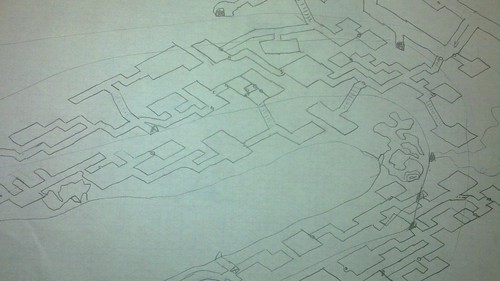
Isomorphic (is that the right term?) maps have captured my attention since first time I saw one. I forget were, Don't think it was Ravenloft which I never owned. For my upcoming International Traditional Gaming Week B2 marathon I decided I'd try and make an isomorphic version of The Caves of Chaos.

Here's (part of) my 1st draft.


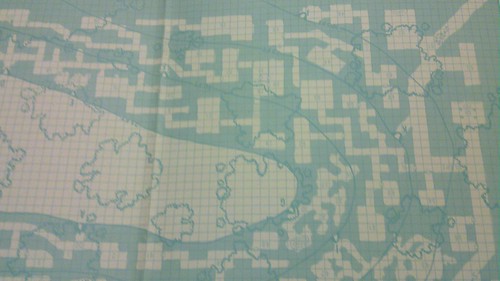
The original "can't copy me cause I'm blue" map.


I got tired of trying to count squares so just started where it seemed right. Irregular caves are hard to draw at an angle. Ran out of space for the temple and some parts of are more non-euclidean than isomorphic. Could make it work by shifting up and to left, squishing the far left stair/dungeon a bit. If I were to finish this I'd ink it up, mark traps and bits and then probably write on the map (in pencil) the room contents/encounters. I like running straight from marked up maps rather than having to refer to module write-up.

I like how it turned out. But, I think I'm gonna use Hackmaster's version of B2 for the marathon. Its map is much larger and has more depth/options than the small, mostly linear lairs of B2. It also has many more prisoner/slaves making that option of introducing new players much more likely. It's maps aren't very multi-level and are too big to fit on my iso paper so little reason to make iso versions of them.

Wednesday, March 3, 2010

The Most Awesome Talk on Future of Games Evar

"Real", not RPG games. Although, there's a great quote about teacher instead of grades giving out xp and leveling up students. This talk blows my mind and the end totally scares me.

All Time Most Popular Posts